
Nikro Air Duct Cleaning in Washington Square: A Homeowner’s Guide
A truck-mount Nikro system pulls up to 16,000 cubic feet per minute of air through your ductwork. The portable vacuum a discount crew rolls through the front door moves closer to 1,500 CFM. That gap isn’t marketing – it’s the difference between air rushing through the system hard enough to lift settled debris off the walls of the duct and a light tug that mostly rearranges it. If you’ve been comparing quotes for air duct cleaning in Washington Square and can’t tell why the numbers swing so widely, the equipment is usually the answer.
What Does Negative-Pressure Cleaning Actually Mean?
Negative-pressure cleaning means the equipment creates a vacuum inside the duct system so strong that air flows inward through every opening – supply registers, return grilles, and any access point the technician cuts – rather than leaking outward into your living room. Every loose particle in the ductwork is being pulled toward the collection unit, not pushed into your hallway.
That’s the mechanical principle. Three things make it work or fail:
- Suction volume (CFM). The higher the rating, the more air the machine can move through a duct of a given size, and the more debris it can carry out. A machine moving 1,500 CFM through a main trunk line is fighting a losing battle against the volume of air that trunk holds.
- A sealed collection path. If the vacuum hose connection isn’t tight, you’re pulling Washington Square’s outdoor air into the machine and getting very little from the duct.
- Agitation. Suction alone won’t lift caked dust from a duct wall. Something has to physically break it loose while the vacuum is running – which is where the rotary-brush side of the equipment comes in.
Negative pressure isn’t a brand claim. It’s a physics description. The Nikro name gets attached to it because Nikro builds machines specifically for that job rather than adapting a shop vacuum platform.
Why CFM Is the Only Equipment Spec That Matters
CFM – cubic feet per minute – is the volume of air a machine can move. When you compare two air duct cleaning quotes in Washington Square, the CFM rating of the vacuum is the single spec that tells you what the technician is actually capable of pulling out of your system. Everything else is detail.
Here’s what that looks like in practice:
| Equipment type | Typical CFM range | What it can realistically handle |
|---|---|---|
| Shop vacuum | 100-200 | Loose surface dust at a register; nothing further in |
| Portable negative-pressure unit | 1,500-2,500 | A single branch line, light soil loads, small systems |
| Truck-mount Nikro system | Up to 16,000 | Full systems including main trunk lines, heavy particulate loads, post-renovation debris |
The higher rating doesn’t just mean “cleaner.” It means the machine can maintain meaningful suction at the far end of a 40-foot trunk line, which is where dust accumulates hardest and where a low-CFM unit gives up entirely. When a discount crew quotes you a very low price, the CFM number is usually the reason. A smaller machine is cheaper to buy, cheaper to run, and takes far less debris out of your ducts.
How Nikro’s HEPA Filtration Loop Keeps Debris Out of Your Home
Extraction is only half of a negative-pressure system. The other half is what happens to the air after it leaves your ductwork. The collection unit’s HEPA filtration stage traps the extracted particulate inside the machine rather than exhausting it into the room where the technician is working – and where you’re sitting.
This matters more than most homeowners realize. Cleaning ductwork is, by definition, releasing a concentrated cloud of whatever was in the system: dust mites, drywall particulate, pet dander, fiberglass fragments from older insulation, and mold spores if there’s a moisture problem. A unit with a proper HEPA final stage captures those particles. A unit without one can turn a cleaning visit into a redistribution event.
In our experience, this is the detail that separates a cleaning appointment you notice the benefit of from one where someone in the household has a rough respiratory week afterward. It’s also why we treat the HEPA stage as a specification to check, not an optional upgrade.
For homes with a known contamination concern – visible mold growth at a register, a recent renovation that filled the return side with drywall dust, or an occupant with diagnosed allergies – we also deploy Abatement Technologies equipment rated for that level of scenario, with Guardsman-grade sanitizing applied to duct surfaces once cleaning is complete. That’s a different tier of job than routine maintenance, and it deserves to be priced and treated as such.
Portable vs. Truck-Mount Nikro: Which Fits a Washington Square Home?
Not every Washington Square property needs a truck-mount unit parked outside. Most single-story homes and smaller apartments run on relatively short, simple duct layouts that a well-maintained portable negative-pressure system can clear effectively – and a portable unit is often the only practical option where parking rules, alley access, or building management make a truck connection impossible.
Truck-mount makes sense when:
- The home has multiple stories with long vertical runs
- There’s a large main trunk line the vacuum needs to hold pressure on
- The job involves heavy soil loads – post-renovation, post-water-damage, or a system that hasn’t been touched in years
- You want the deepest possible clean on a system with a lot of square footage of duct surface
The honest answer is that a good technician matches the machine to the job and tells you which one they’re using and why. If you live in a Washington Square building where a truck can’t reach the connection point, a portable unit running properly beats a truck-mount unit that isn’t actually connected to your system.
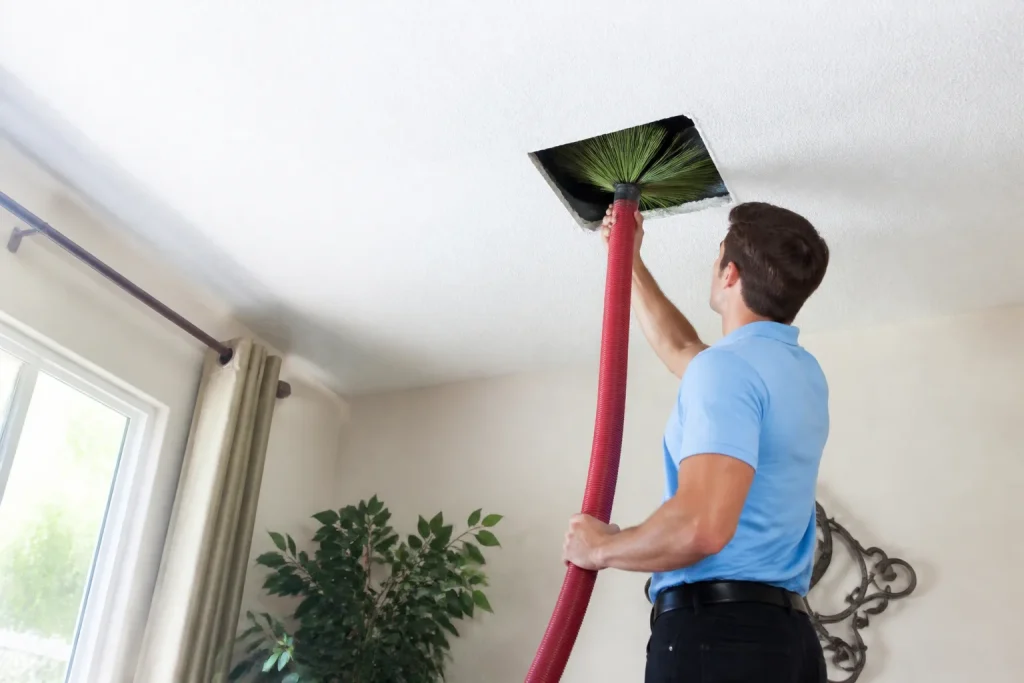
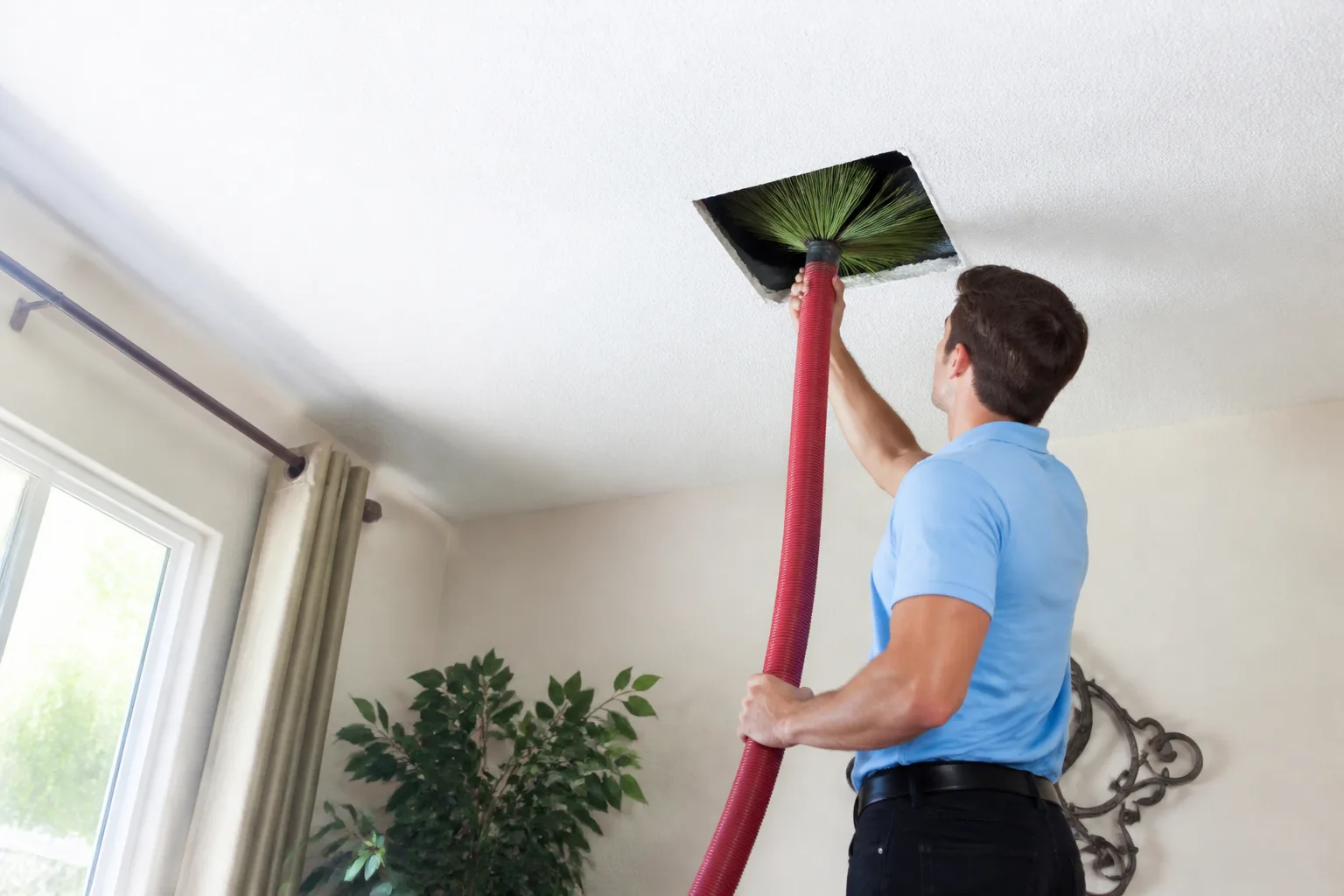
Rotobrush rotary-brush equipment handles the mechanical agitation inside the ducts either way – the brush loosens the debris, the vacuum carries it out. Purpose-built equipment, not repurposed shop vacuums, is the standard we hold to.
The Access-Point Protocol Generalist Techs Skip
Negative-pressure cleaning only works if the technician creates the right openings in the duct system. A proper job involves cutting access points at calculated intervals along the duct run – near the plenum, at the base of vertical drops, and along long horizontal sections – so the rotary brush and the vacuum can reach every section rather than just the first few feet.
Those access points get sealed afterward with properly rated materials, airtight and matched to the duct material. Skipping them, or sealing them sloppily, leaves you with a system that leaks air into a wall cavity instead of your living room.
A generalist HVAC technician who adds duct cleaning to their service list often skips the access protocol for a practical reason: it takes time and requires the right sealing materials. Instead, they’ll clean through the existing registers only, which reaches the last few feet of each branch line and leaves the trunk untouched. That’s why we treat the access protocol as a verification point, and why we seal the system after cleaning – so it stays clean.
If cleaning reveals cracks, disconnected sections, or deteriorating duct sealant, that’s a repair job, and it needs to happen before the system gets put back into service. We handle HVAC cleaning and duct repair and sealing as part of the same visit, so you’re not chasing a second contractor to fix what the first one found.
How to Verify a Technician Actually Used the Nikro System on Your Job
The uncomfortable truth is that some operators bring professional-looking equipment to the door and then do the actual cleaning with a shop vacuum and a leaf blower worth of suction. You can verify what happened with a few straightforward checks.
- Look at the machine. A Nikro unit is a substantial piece of equipment with a brand plate, and a truck-mount setup involves a large-diameter hose running from outside to your duct connection. If the hose never appears, the vacuum never connected.
- Count the access points. A proper job leaves visible, neatly sealed access points along the duct runs. Ask where they were cut and look at the seals afterward.
- Ask for before-and-after photos. A crew running a genuine extraction process takes them because the results are the proof. If photos can’t be produced, treat that as an answer.
- Check the filter condition. Ask to see the collection unit’s filter before and after. A HEPA filter that pulled real debris out of a Washington Square home will show it.
- Watch for the CFM tell. A machine that pulls up to 16,000 CFM sounds and feels like it’s moving serious air – you’ll notice a strong draw at registers while it runs. A shop vacuum doing the work sounds like a shop vacuum.
When to Call a Pro
Routine duct cleaning is a scheduled maintenance item. It’s not an emergency, and it’s not a DIY job – reaching the inside of a duct run properly takes equipment that a homeowner can’t buy at a hardware store. Where it becomes genuinely urgent is the dryer vent side of the system: lint accumulation in a dryer duct is a fire risk, and dryer vent cleaning is a fire-prevention appointment, not an add-on.
For the duct system itself, call a professional when you notice musty odors coming from registers, visible dust blowing out when the system starts, a recent renovation that filled the returns with particulate, or a home inspection flagging the ductwork. Those are the signals that the system has accumulated more than a maintenance-level soil load.
If you’d rather not spend a weekend figuring out which quote in your inbox is legitimate, call (877) 792-6053 and we’ll talk through what your system actually needs.
Related services in Washington Square: air duct cleaning for full systems, and dryer vent cleaning as a standalone safety service.
The Bottom Line
Nikro equipment matters because CFM matters, HEPA filtration matters, and access-point protocol matters – and all three are checkable. The vacuum’s suction rating tells you what can physically come out of the ductwork. The filtration loop tells you whether it stays out of your living space. The access points tell you whether the technician reached the whole system or just the front door.
We use Rotobrush rotary-brush equipment alongside Nikro negative-pressure systems, with HEPA filtration through the extraction loop, because it’s the equipment that gets the job verified from first pass to final seal. Our technicians have up to 8 years of experience working this equipment on residential and light-commercial systems. Once the ducts are clean, Aprilaire and Honeywell air-quality components are the natural next step if you want the system to stay cleaner between visits.
- CFM is the equipment spec that separates real extraction from cosmetic cleaning
- HEPA filtration in the collection unit is what keeps debris out of your air
- Portable and truck-mount Nikro units serve different home types – ask which one applies to yours
- Access points get cut, used, and sealed as part of a proper job
- Before-and-after photos and filter condition are the verification tools available to you
If you’re in Washington Square and need help, Air Duct Cleaning Washington Square offers free estimates – call (877) 792-6053. We answer 24/7. Fast dispatch from 7am to 7pm, Sunday through Friday. The price is set per job by a written estimate agreed before any work starts, and you see before-and-after photos of your own ducts.
Frequently Asked Questions
Yes, on the spec that matters most: CFM. A truck-mount Nikro system pulls up to 16,000 CFM versus roughly 1,500 CFM from a typical portable unit and a couple hundred from a shop vacuum. Higher suction volume means the machine can maintain real extraction pressure at the far end of a duct run instead of only near the register. Call (877) 792-6053 for an exact quote on your system – estimates are free.
It depends on system size, duct layout, and soil load, which is why we quote per system rather than per vent. A written estimate sets the price before work starts. Be cautious of quotes that undercut everyone else by a wide margin – that usually means a smaller machine, fewer access points, or no HEPA stage. Call (877) 792-6053 for an exact quote – estimates are free.
Cheaper quotes usually reflect cheaper equipment and a shorter process. A crew using a low-CFM portable vacuum, cleaning only through existing registers, and skipping the access-point cuts can complete a job far faster than a proper negative-pressure cleaning. You’re not comparing the same service. Ask each contractor what CFM their machine is rated for and whether they cut and seal access points.
Ask for before-and-after photos of your own ductwork, ask to see the collection unit’s filter after the job, and look at the access points – properly cut and sealed openings are visible and should be airtight. A technician who ran genuine Nikro extraction can show all three without hesitation. Call (877) 792-6053 to book a free estimate.
Written by the team at Air Duct Cleaning Washington Square.
Need Air Duct Cleaning Help?
Call Air Duct Cleaning Washington Square - the local pro we connect you with is licensed and insured, here with fast help in Washington Square.
(877) 792-6053